Democratic Governance & Women's Rights Analysis
Why I Built This
My wife is a lawyer specialized in human rights. While working as a visiting scholar at American University, she conducted a qualitative analysis of the relationship between democracy and women’s rights - examining how different governance systems shape the legal protections available to women. During that work she introduced me to the World Bank Women, Business and the Law research, a dataset that systematically scores every country’s legal framework across dimensions of women’s rights.
I immediately thought it would be interesting to take her non-quantitative analysis and turn it into a data science project. I wanted to confirm her perspective and understanding with definitive numbers and using statistical methods.
Overview
I developed this as a capstone project for MSML602: Principles of Data Science at the University of Maryland (Spring 2025).
The motivation was to understand and confirm the pre-concept that living under a democratic system translates to better outcomes for women’s rights, and to analyze whether religion is a meaningful moderating factor. Progress in women’s rights over the last century has not been linear or permanent — over the last decade, a resurgence of conservative and authoritarian movements has put many of those protections at risk — and I wanted to quantify how much of that variation can be explained by a country’s democratic governance.
The basis for measuring women’s rights was the World Bank Women, Business and the Law research: an exhaustive analysis of the legal frameworks of countries around the globe, scoring how each country defines women’s rights and equality across areas like mobility, workplace protections, marriage law, maternity leave, and access to pensions.
Approach
I structured the analysis in four progressive stages:
-
Data preparation - Seven independent datasets were cleaned, normalized, and merged into a unified cross-country format. Sources include Polity5, Freedom in the World, LIED (a cross-national dataset of electoral democracy), the Georgetown Women, Peace and Security Index, global religious diversity indices, and World Bank economic indicators.
-
Exploratory analysis - I applied Principal Component Analysis (PCA) independently to each dataset to identify the most significant dimensions of variation across countries, and to understand what each index was actually capturing before combining them.
-
Regression modeling - I used linear regression to quantify the relationship between women’s rights scores and multiple democracy indices, comparing different frameworks for measuring democratization to see which correlated most strongly.
-
Advanced modeling - I applied SVM classification, clustering, decision trees, and religion-informed regression models to incorporate geographic and cultural variables and identify where the democracy-rights relationship breaks down.
Each stage has its own notebooks in the repository - the code, intermediate outputs, and inline commentary walk through the analysis in more detail than I can cover here. If you want to dig into the methodology, that’s the best place to start.
Results
The starting point is the geographic distribution of both variables. Comparing the two maps side by side, the pattern is already visible before any modeling: the regions with the lowest women’s rights scores (green and light tones in Africa and the Middle East) overlap closely with the regions scoring lowest on democracy (dark purple across the same areas).
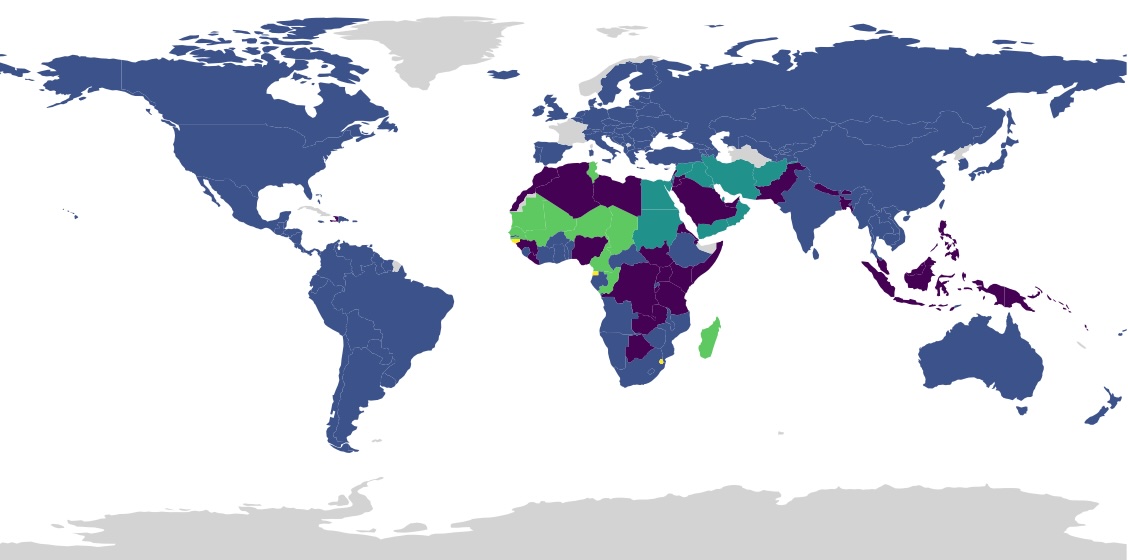
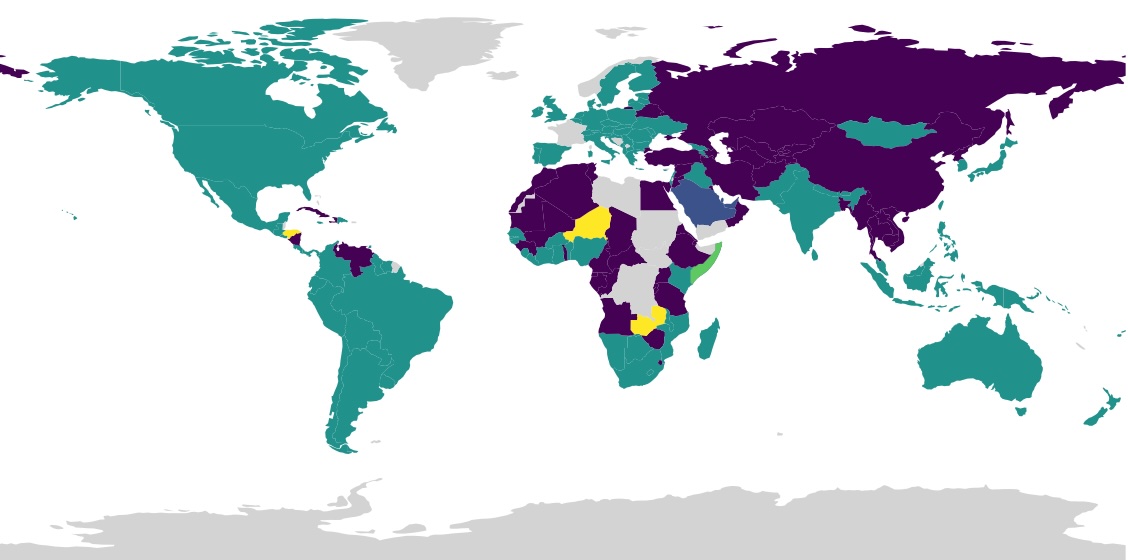
The study confirmed the hypothesis: women’s legal rights are strongly correlated with democratic governance, particularly across the Americas, Europe, and Asia. The relationship is clearest in specific legal domains - equal pay, marriage equality, maternity protections, and pension access.
The correlation does not hold uniformly across all regions. In Africa, Oceania, and Muslim-majority countries, the relationship is weaker, pointing to cultural or institutional moderating factors that democracy scores alone do not capture. Clustering analysis revealed country groupings that cut across geographic regions, suggesting that governance structure and religious context together explain women’s rights outcomes better than geography alone.
Stack
- Tools: Pandas, NumPy, Scikit-learn
- Methods: PCA, Linear Regression, SVM, K-Means Clustering, Decision Trees